
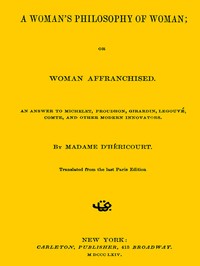
A Woman's Philosophy of Woman; or, Woman affranchised. by Madame d' Héricourt
I discovered this gem while diving into classic feminist texts, and let me tell you, ‘A Woman's Philosophy of Woman’ is not the dusty pile of outdated opinions you'd expect. Actually, it feels so alive—like listening to a really smart friend dismantling every bad argument against women's equality with careful logic and serious sass.
The Story
Madame d’Héricourt was writing in a time when male philosophers kept trying to ‘define’ women’s nature. Men like Proudhon and Michelet had this idea that women’s highest calling was to be ‘the companion of man’—basically, their mission in life was love and domestic duty. And some other thinkers wanted to 'free' women, but their version of freedom was still limiting (role of spiritual mother, anyone?). Madame says, nah. So she up and argued back in a series of open letters published in newspaper.
The book collects these letters plus her fuller thoughts: societies had it wrong—tying women rigidly to procreation and family. She argues that reason and truth stand above male-or female-given labels. Her core point? Give the same education and rights to women as men, and see them bloom, unencumbered. That's the story: one intellectual woman against a whole wave of male philosophers. And she beats them at their own logic game.
Why You Should Read It
For starters, the sass is off the charts. She writes calmly but through sophisticated arguments, while joyfully taking apart the pseudo-science and back-of-the-napkin philosophies of her time. Perhaps you like smart nerds arguing? Yes!
Besides its historical value, there’s a stunning radical theme here I love: she says women deserve the same cultivation of their mind because truth is common to all human beings, no gender needed. There’s equality rooted in the potential of every soul. Honesty: it feels refreshingly practical—no victim-talk, pure focus on removing road blocks like citizenship, property, education. Her argument for married women's control over income? That single passage could fuel a modern policy debate.
Also, many points feel shockingly current—especially discussions on “female nature.” Two centuries later and some people still won't get the need for independence and choices. Heritage with a bite!
Final Verdict
This book is for you if you love historical philosophical boxing matches. It is fit for feminist pilgrims who laugh reading Mary Wollstonecraft; if you find Mid-1800s arguments wild yet illuminating. For perfect reading think: a combination of both history of LGBTQ/book club discussions, maybe even brunch scenes where someone says “woman’s role is motherhood alone,” throw not bread but d’Héricourt quotes? Ah! Perfect for book-geeks looking through lost chapters and modern folks wanting evidence: the fight grew smarter once a Parisien dinner-table—force of thought passed page there. Throw it in.
This title is part of the public domain archive. Feel free to use it for personal or commercial purposes.
Emily Jones
1 year agoI started reading this with a critical mind, the historical context mentioned in the early chapters is quite enlightening. Thanks for making such a high-quality version available.
George Anderson
8 months agoI found the author's tone to be very professional yet accessible, the inclusion of diverse viewpoints strengthens the overall narrative. This has become my go-to guide for this specific topic.
Margaret Gonzalez
3 weeks agoThe digital formatting makes it very easy to navigate.
Emily Johnson
6 months agoThis is an essential addition to any academic digital library.





Nancy Brown
6 months agoIf you're tired of surface-level information, the visual layout and supporting data make the reading experience very smooth. A solid investment for anyone's personal development.