
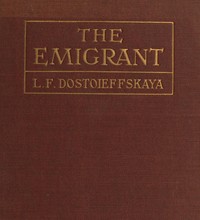
The Emigrant by L. F. Dostoevskaia
Okay, let's talk about this hidden gem. 'The Emigrant' isn't a book you stumble upon every day, and that's part of what makes it so special.
The Story
The novel follows Anna, a young woman from an educated Russian family. When the Revolution turns her world upside down, she manages to escape, but her journey lands her not in a glittering European city, but on a remote farm in Saskatchewan. The plot is simple on the surface: Anna must learn to survive. She battles the unrelenting cold, masters chores she's never done, and navigates the wary, sometimes kindly, distance of her Canadian neighbors. But the real story happens inside her head. We see her memories of Saint Petersburg clash with the stark reality of the prairie. Letters from lost friends arrive, stirring up grief and guilt. The local community views her as an oddity—a 'Russian lady' who doesn't belong. The central question isn't whether she'll physically survive, but whether she can ever feel at home again, or if she'll remain a ghost of her former self, forever caught between two worlds.
Why You Should Read It
I was completely drawn in by Anna's voice. Dostoevskaia writes with a piercing honesty that feels modern. This isn't a romantic tale of frontier adventure. It's a raw, sometimes uncomfortable, look at cultural dislocation. You feel Anna's loneliness in your bones—the isolation of not being able to share your history with anyone around you. What struck me most were the small moments: Anna desperately trying to keep a single, treasured book dry, or the way the taste of a certain food could trigger a flood of memories. The book asks big questions about identity and sacrifice without ever sounding preachy. It made me think about what we carry with us and what we're forced to leave behind.
Final Verdict
This book is perfect for readers who love quiet, character-driven stories and untold historical perspectives. If you enjoyed the emotional depth of novels like Hamnet or the immigrant experience in Pachinko, but want a more intimate, focused lens, you'll connect with this. It's also a fascinating read for anyone interested in the Russian diaspora or early 20th-century history from a deeply personal angle. Don't go in expecting a fast-paced plot. Go in ready to walk alongside a compelling character through one of life's most difficult transitions. It's a beautiful, sobering, and ultimately resilient story that stayed with me long after I turned the last page.
This digital edition is based on a public domain text. You do not need permission to reproduce this work.
Nancy Anderson
1 year agoThis was exactly the kind of deep dive I was searching for, the transition between theoretical knowledge and practical application is seamless. It definitely lives up to the reputation of the publisher.
Susan Gonzalez
4 months agoIt’s refreshing to see such a high standard of digital publishing.
George Lopez
5 months agoExceptional clarity on a very complex subject.
Christopher Lopez
3 months agoThis was exactly the kind of deep dive I was searching for, the transition between theoretical knowledge and practical application is seamless. A perfect balance of theory and practical advice.



Margaret Gonzalez
2 years agoI appreciate the objective tone and the evidence-based approach.