
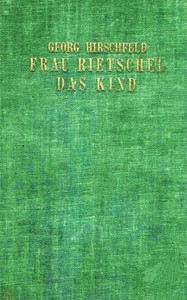
Frau Rietschel das Kind : Roman by Georg Hirschfeld
Let me set the scene for you. It's Germany in the early 1900s. We meet Frau Rietschel, a woman who, on the surface, seems to live a quiet, respectable life. But from the very beginning, Hirschfeld lets us feel that something isn't right. Her world revolves around a singular, consuming focus: a child. This isn't a simple maternal longing. It's an obsession that colors everything she does and sees, a ghost that haunts her daily routine.
The Story
The plot follows Frau Rietschel's life as she moves through her days, interacting with neighbors and going about her business. But her internal world is a different story. Her thoughts are constantly pulled back to this child. The genius of the book is that Hirschfeld doesn't give us easy answers. Is the child a memory of one she lost? A symbol of her own lost youth or innocence? A fantasy she uses to escape her present? The story slowly peels back the layers of her psyche. We watch as the pressure of this obsession begins to affect her reality, blurring the lines between what is remembered, what is imagined, and what is truly happening. It's a masterful, quiet unraveling.
Why You Should Read It
This book hooked me because of its incredible focus on internal life. In an age of constant noise, reading about Frau Rietschel's quiet desperation felt strangely powerful. Hirschfeld doesn't judge his character; he simply shows us her world from the inside. You don't just observe her, you start to feel the weight of her fixation. It's a brilliant study of how trauma, memory, and desire can trap a person. The setting isn't just backdrop—the social expectations of the time act like a cage, making her internal struggle even more intense. You're left piecing the puzzle together yourself, which makes the experience deeply personal.
Final Verdict
This is a book for the patient reader who loves getting inside a character's head. If you enjoy subtle, psychological stories more than action-packed plots, this is for you. It's perfect for fans of early 20th-century literature who want to explore a lesser-known voice. Think of it as a character portrait, a slow and haunting examination of a fractured mind. Be prepared for ambiguity—Hirschfeld trusts you to sit with the questions. It's a short but dense read that stays with you long after you've turned the last page.
You are viewing a work that belongs to the global public domain. It is available for public use and education.
David King
11 months agoAfter hearing about this author multiple times, it manages to explain difficult concepts in plain English. Don't hesitate to start reading.
Brian Jones
1 year agoEssential reading for students of this field.
Joseph Clark
1 year agoNot bad at all.
Richard Lewis
1 year agoGreat digital experience compared to other versions.
Jennifer Jackson
2 years agoIt effectively synthesizes complex ideas into a coherent whole.