
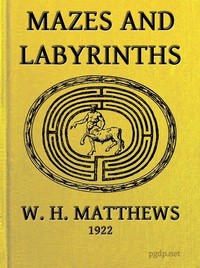
Mazes and Labyrinths: A General Account of Their History and Development
Published back in 1922, W.H. Matthews's Mazes and Labyrinths is less of a story with a plot and more of a guided expedition. Think of Matthews as your incredibly knowledgeable, slightly old-fashioned tour guide. He doesn't just show you the famous garden mazes at Hampton Court; he starts at the very beginning.
The Story
Matthews structures his journey like a detective tracing a single, winding clue. He begins with the legendary Labyrinth of King Minos in Crete, separating the myth from what archaeologists have actually found. From there, he follows the thread across the ancient world, into Roman mosaic floors, and through the Middle Ages, where labyrinths were carved into cathedral stones for symbolic pilgrimages. The trail then leads outdoors to the "turf mazes" of the English countryside—simple grass paths cut into hillsides whose original purpose is still debated. Finally, he explores how the same concept appears independently in cultures from Scandinavia to the American Southwest, in everything from stone arrangements to woven baskets. The "story" is the surprising persistence of this one idea.
Why You Should Read It
What makes this century-old book so compelling is its sense of quiet wonder. Matthews isn't writing a dry textbook; he's genuinely curious. You can feel his excitement when he describes trying to find a forgotten turf maze or puzzling over an old manuscript. He connects dots you'd never think to connect, showing how a child's game, a religious symbol, and an architectural marvel can all spring from the same human impulse. It makes you look at the world differently. Suddenly, a spiral on a church floor or a puzzle in a newspaper isn't just a design—it's part of a conversation humans have been having for millennia.
Final Verdict
This book is a perfect, slow-burn read for curious minds who love history, design, or folklore. It's for the person who enjoys connecting big ideas and doesn't mind a slightly academic, but always clear, writing style from another era. If you're looking for a fast-paced thriller, this isn't it. But if you want to be thoroughly convinced that something as simple as a path that doubles back on itself is one of humanity's oldest and most profound ideas, then get lost in this book. It's a classic for a reason.
No rights are reserved for this publication. Preserving history for future generations.
Mason Miller
3 months agoI started reading out of curiosity and the clarity of the writing makes this accessible. One of the best books I've read this year.
Noah Harris
11 months agoAs someone who reads a lot, the pacing is just right, keeping you engaged. A true masterpiece.
Lucas Rodriguez
6 months agoHonestly, the content flows smoothly from one chapter to the next. Exceeded all my expectations.
Kenneth Martinez
1 year agoVery helpful, thanks.





Susan Ramirez
1 year agoLoved it.