
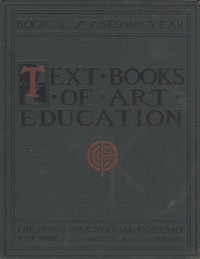
Text books of art education, v. 2 of 7. Book II, Second Year by Froehlich and Snow
Let's clear something up right away: this isn't a storybook. There's no protagonist or villain in the traditional sense. Text Books of Art Education, Book II is a practical manual for teachers and students from 1904, designed for the second year of structured art lessons.
The Story
The 'plot' is the progression of skill. The book starts with the absolute basics—straight lines, curves, simple geometric shapes—and treats them with serious respect. It moves on to how these elements combine to form leaves, buds, and other natural forms. Then, it introduces color theory through primary colors and guides the student in mixing secondary and tertiary hues. The final sections apply these skills to decorative design, like creating borders and simple patterns. The entire journey is framed not as copying a masterwork, but as understanding the underlying principles of form, balance, and harmony.
Why You Should Read It
My favorite part is the book's quiet confidence. Snow and Froehlich weren't just teaching art; they were teaching a way of thinking. They argue that careful observation and construction are the keys to true creative freedom, which feels incredibly relevant today. Reading their clear, step-by-step instructions, you get a sense of their belief that every child is capable of developing an artistic eye. It's a philosophy of education that values process over product, a reminder that beautiful, complex things are built from simple, honest parts.
Final Verdict
This is a niche read, but a rewarding one. It's perfect for history of education buffs, artists curious about foundational pedagogy, or anyone who loves peeking into the mindsets of a past era. You won't get thrilling narratives, but you will get a surprisingly intimate look at how two educators a century ago hoped to shape the way young people see the world around them. It's a patient, principled, and ultimately hopeful little book.
This book is widely considered to be in the public domain. Enjoy reading and sharing without restrictions.
Sarah Taylor
9 months agoA sophisticated analysis that fills a gap in the literature.
Paul Thomas
1 year agoUnlike many other resources I've purchased before, the objective evaluation of the pros and cons is very refreshing. Definitely a five-star contribution to the field.
Paul Harris
6 months agoThe author provides a very nuanced critique of current methodologies.
Kimberly Johnson
1 year agoAs a professional in this niche, the author doesn't just scratch the surface but goes into meaningful detail. A solid investment for anyone's personal development.







Susan Smith
1 year agoIt’s refreshing to see such a high standard of digital publishing.